
68
The dream of an amphibious wilderness route is undeniably compelling. You hike across high alpine passes, traverse ridgelines where roads never venture, and drop down into a remote river canyon to float out on current rather than retracing your footsteps on foot. It is one of the most rewarding ways to experience backcountries that remain inaccessible to single-discipline travelers.
Yet turning that vision into a successful trip hinges almost entirely on the vessel rolled up inside or strapped across your backpack. Adventurers stepping into multi-sport routes frequently treat packrafts and inflatable kayaks as interchangeable categories of portable boats. In reality, they are engineered for fundamentally distinct mission profiles. Confusing their strengths turns a scenic backcountry linkup into a miserable physical slog, or worse, an unstable water hazard. Selecting the right watercraft requires an honest assessment of trail miles, water conditions, and the physiological toll of carrying your boat over rugged terrain.
The Brutal Reality of Trail Weight and Packed Bulk
The central friction point of any hike-and-paddle route is not what happens on the river; it is what happens on your spine during the approach hike. This is where the divide between an inflatable kayak and a purpose-built packraft becomes stark.
A true backcountry packraft relies on lightweight, high-tenacity thermoplastic polyurethane (TPU) coated nylon. A standard open-deck white-water or touring packraft weighs between five and nine pounds. When deflated and rolled, it occupies roughly the same space as a two-person four-season tent. That compact footprint allows you to pack the boat, along with your breakdown four-piece paddle, inflation sack, and personal flotation device (PFD), entirely inside a standard 60-to-70-liter multi-day backpack alongside your food and sleeping system.
Inflatable kayaks, often constructed from heavy-gauge polyvinyl chloride (PVC) or thick rubberized fabrics, occupy a completely different weight class. Even lightweight solo inflatable kayaks rarely weigh less than twenty pounds, with mid-range and drop-stitch models routinely tipping the scales between twenty-five and forty pounds. Furthermore, their deflated bulk resembles a large, unyielding duffel bag that cannot fit inside a standard wilderness pack. Lashing a thirty-pound cylinder to the exterior of an already heavy load drastically shifts your center of gravity backward, punishing your knees on steep mountain descents and turning dense brush into an agonizing obstacle course. If your route features more than two or three miles of sustained foot travel or significant elevation gain, a traditional inflatable kayak simply imposes an unacceptable physical penalty.
Hull Hydrodynamics and On-Water Performance
Once you reach the riverbank and inflate your craft, the trade-off shifts in the other direction. Hydrodynamics, hull rigidity, and tracking mechanics determine how much energy you expend covering river or lake miles.
The Tracking Efficiency of Inflatable Kayaks
Where inflatable kayaks excel is on flat, open water. Modern inflatable kayaks—especially those featuring high-pressure drop-stitch floors or integrated aluminum frame ribs—boast narrow beams, defined keels, and removable tracking skegs. These design features allow the boat to glide through the water efficiently, tracking straight with minimal lateral yaw on every stroke. On large backcountry lakes, coastal estuaries, or broad, sluggish rivers where you must paddle continuously to make progress, an inflatable kayak cuts through headwinds and surface chop with superior speed, typically cruising between three and four miles per hour with modest effort.
The Maneuverability and Drift of Packrafts
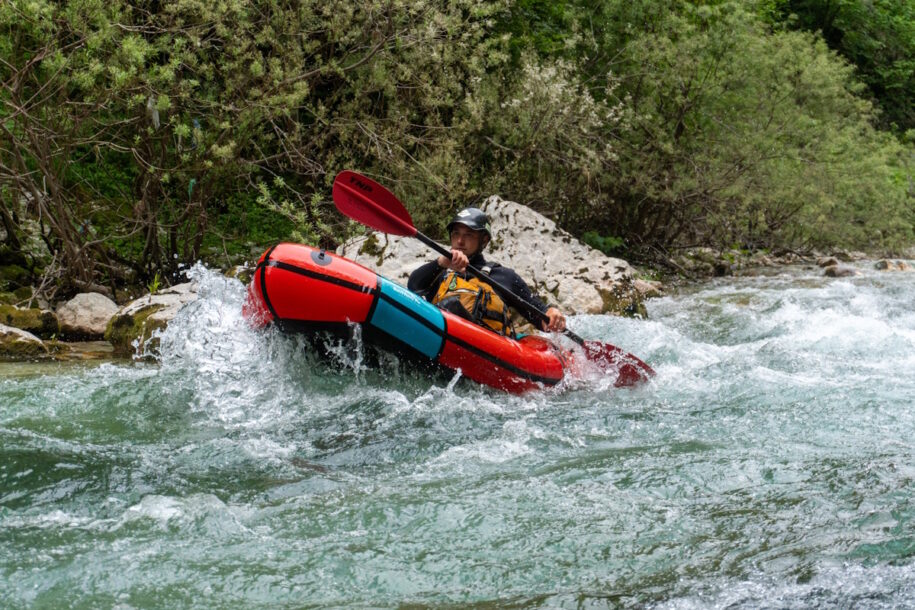
Packrafts, by contrast, are fundamentally short, wide, flat-bottomed rafts with blunt sterns and upturned bows. They have no rigid keels or deep skegs. Because of their immense buoyancy-to-weight ratio, they ride on top of the water rather than in it. This design makes them supremely forgiving in shallow, rock-strewn creeks, boulder gardens, and technical whitewater, allowing a paddler to spin on a dime, ferry across strong currents, and ride over standing waves that would swamp a long boat.
The downside to this hull geometry is flatwater drag. Packrafts are slow, generally averaging two to two-and-a-half miles per hour under steady paddling. Without a skeg, each paddle stroke pushes the bow slightly off-center. More critically, their buoyant, high-profile tubes act like sails in open terrain. If your backcountry route requires crossing a five-mile mountain lake against a twenty-knot afternoon crosswind, paddling a packraft will demand immense grit, constant corrective strokes, and patience.
Gear Capacity and Weight Distribution Systems
Carrying several days of camping equipment introduces complex stability dynamics on moving water. How each craft accommodates that cargo drastically changes handling characteristics.
Traditional inflatable kayaks generally rely on above-deck storage. You strap dry bags across the bow and stern decks or wedge them between your knees in an open cockpit. Placing heavy gear high above the waterline raises the craft’s center of gravity, which compromises secondary stability in rough current and increases wind resistance on open expanses.
Backcountry packrafts solved this problem through an ingenious engineering leap: internal cargo zipper systems. Using airtight, pressure-proof zippers built directly into the rear pontoon, paddlers can slide dry bags inside the inflated tubes of the raft itself. Stowing heavy food bags, shelter, and clothing inside the pontoons lowers the boat’s center of gravity beneath the waterline, effectively increasing stability in turbulence. It also leaves the cockpit spacious and clear while shielding your critical survival gear from exterior abrasion or river loss during a flip.
Durability and Remote Field Repairability
In deep backcountry, a hull failure is an immediate trip-ending emergency. Both crafts handle abrasion differently, and their materials dictate how easily you can recover from a puncture.
Inflatable kayaks built with heavy commercial PVC are remarkably tough against direct blunt impacts, but they are stiff and cumbersome to mend in the woods. PVC solvent adhesives require precise temperature ranges, clean surfaces, and lengthy cure times that are difficult to manage when huddled under a tarp in the rain.
Packrafts trade pure material thickness for tensile strength. High-end TPU nylon flexes and yields over sharp submerged river gravel rather than tearing. When a puncture or tear does occur from a jagged branch or sharp shale edge, field repairs are exceptionally straightforward. Clean the puncture site and apply an aggressive polyurethane repair tape, such as Tenacious Tape or specialized pressure-sensitive patches. The repair seals instantly without curing time, allowing you to re-inflate the tube and resume your route within fifteen minutes.
Matching the Watercraft to Your Route Profile
Choosing between these two crafts comes down to a clear geographical calculation: evaluate your ratio of foot travel to paddle travel, and examine the nature of the water you intend to run.
Choose a packraft if:
-
Your approach involves long hiking trail miles, cross-country bushwhacking, or technical ridge crossings where gear weight must remain low.
-
Your water segment includes shallow, rocky rivers, remote headwaters, or Class II to Class IV whitewater where maneuverability and rapid self-rescue matter.
-
You are planning an expedition loop that starts and finishes at a trailhead without vehicle shuttle support.
-
You need all your paddling gear to stow cleanly inside a single backpack for airline flights or train transit.
Choose an inflatable kayak if:
-
Your route involves short portages, gentle shoreline carries under two miles, or vehicle-supported access points.
-
Your itinerary consists primarily of open flatwater lakes, slow-moving coastal inlets, or broad, deep rivers with minimal technical obstacles.
-
You prioritize paddling speed, effortless tracking, and cockpit comfort over trail portability.
-
You are traveling on a modest budget, as recreational inflatable kayaks are often significantly less expensive than technical wilderness packrafts.
The ideal backcountry vessel is the one that respects the physical realities of your entire journey, not just the water portion. By honoring the trade-off between trail weight and open-water tracking, you can pick the craft that turns an ambitious line on a topographic map into a seamless wilderness adventure.
